
NPRR 1330: What Higher RMR Dispatch Prices Mean for Your Power Model
ERCOT MARKET INTELLIGENCE
NPRR 1330: What Higher RMR Dispatch Prices Mean for Your Power Model
How the new Mitigated Offer Cap rule changes price formation — and what you need to model differently this summer
May 2026 | Vulcan by SynMax
What You Will Know After Reading This
Why ERCOT’s Winter Storm Fern dispatch prices were artificially suppressed — and why that cannot happen again under NPRR 1330.
Exactly how the new Mitigated Offer Cap (MOC) mechanism works and what it means for price formation during tight system conditions.
How to pressure-test your generation stack model before the summer peak using Vulcan’s unit-by-unit build outlook.
The Problem: An Out-of-Market Unit Was Setting Market Prices
If you model ERCOT power prices, you need to understand what broke during Winter Storm Fern — and what NPRR 1330 just fixed.
ERCOT holds a Reliability Must-Run (RMR) contract with CPS Energy for Braunig Unit 3, a generator that runs out-of-market purely for local transmission reliability. Under the rules in place before NPRR 1330, SCED’s offer mitigation logic treated RMR units like any other market resource. The result: during constrained conditions, Braunig 3 was dispatched ahead of competitive market resources — actively displacing the very capacity that could have cleared the constraint on its own.
This was not a theoretical concern. It played out in real time.
Winter Storm Fern: A Case Study in Distorted Price Formation
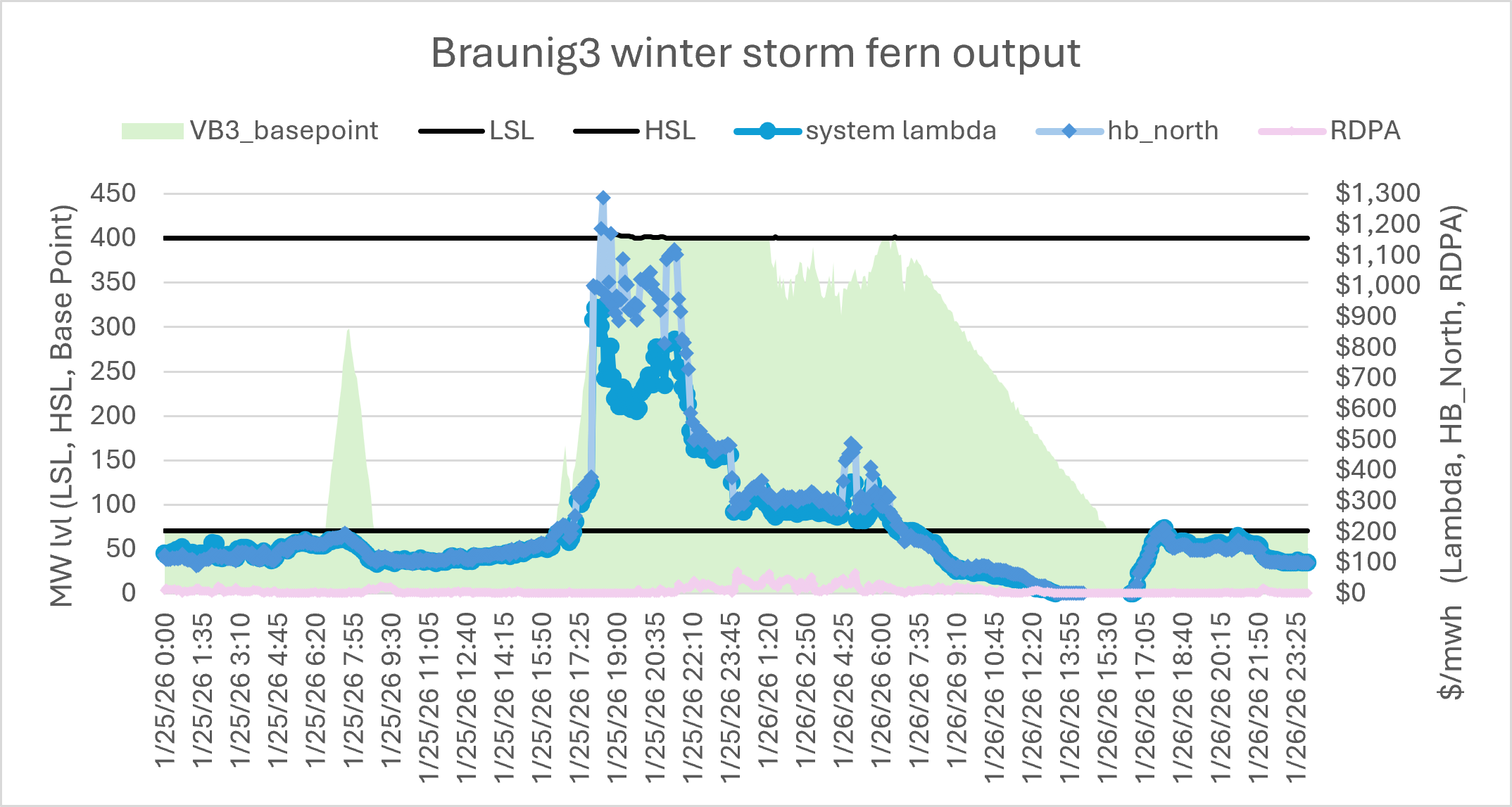
On January 25–26, 2026, during Winter Storm Fern, Braunig Unit 3 was dispatched well ahead of competitive resources under the existing mitigation rules. Analysis of ERCOT’s 60-Day SCED Disclosure for January 25 reveals the core contradiction:
What Braunig 3 Was Offering
Submitted offer price: $5,000/MWh
Implied intent: dispatch only at the market ceiling
Actual behavior: dispatched at essentially cost
What the Market Saw
Competitive market prices were significantly lower
Significant MW of competitive capacity was displaced
True marginal cost to resolve the constraint was never revealed
The submitted $5,000/MWh offer was never honored. Instead, mitigation rules forced Braunig 3 into dispatch at variable cost, pushing out competitive resources and preventing the market from discovering the true clearing price needed to resolve the constraint. Under NPRR 1330, that dynamic changes entirely.
What NPRR 1330 Does: A Flexible, PUCT-Approved Price Mechanism
NPRR 1330 creates a new Protocol Section 4.4.9.4.3 giving ERCOT a PUCT-approved mechanism to set a Mitigated Offer Cap (MOC) curve for each RMR unit. The design principle is straightforward:
The MOC Design Principle
The MOC is set at the highest price ($/MWh) that still allows SCED to dispatch the RMR unit — but only after all competitive resources capable of resolving the relevant transmission constraint have been exhausted.
In plain terms: RMR units go last in the merit order. Competitive resources get dispatched first. The RMR unit only clears when no market alternative remains.
MOC values are published to market participants via Market Notice at contract activation and whenever values change.
Implementation: Fast and Low-Cost
One of the more notable aspects of NPRR 1330 is its implementation path. No IT project is required. ERCOT can implement via a manual process immediately upon PUCT approval, effective the first of the following month. Cost and staffing impact: none.
NPRR 1330 is explicitly a short-term bridge — it revives the approach from NPRR 784 (rejected in 2016) as a stopgap while the permanent solution, NPRR 826 (ERCOT Board-approved in 2020), completes its full system implementation. Once NPRR 826 is live, NPRR 1330 is retired concurrently.
PRS Ballot Results — May 6, 2026
NPRR 1330 cleared both PRS votes on the same day with unanimous support across all seven market segments (7–0, one abstention from Occidental in the Consumer segment):
- Vote 1 — Grant Urgent Status: Passed 7–0
- Vote 2 — Recommend Approval as Submitted: Passed 7–0
- Segments voting yes: Consumers, Cooperatives, Independent Generators, Independent Power Marketers, Independent REPs, Investor-Owned Utilities, Municipals
- NPRR 1330 forwarded to TAC with the April 21 Impact Analysis
- Unit-by-unit commercial operation date forecasts
- Satellite-verified construction progress for projects under build
- Proactive updates as project timelines change
What This Means for Your Power Model
The directional conclusion is clear: under conditions resembling Winter Storm Fern, NPRR 1330 produces materially higher prices than the pre-Fern rules allowed.
When Braunig 3 was dispatched near cost during Fern, it suppressed the price that would have otherwise been needed to clear the constraint through competitive dispatch. With the MOC in place, the RMR unit moves to the back of the merit order. Competitive resources clear first. If the constraint persists to the point where Braunig must run, the market will have already exhausted cheaper alternatives — and the clearing price will reflect that scarcity.
An Important Caveat on the MOC Formula
The current MOC formulation assumes $0 system lambda, which is unrealistic under tight system conditions. The MOC is a meaningful improvement over the prior structure, but it is not a perfect representation of true marginal cost during stressed hours.
Bottom line: prices under NPRR 1330 will be higher than Fern — but may still understate the true economic cost of constraint resolution in the most severe scenarios.
Summer Outlook: How Often Does This Matter?
The mechanism is in place. The question for your model is frequency: how often will ERCOT face conditions tight enough to put it to work?
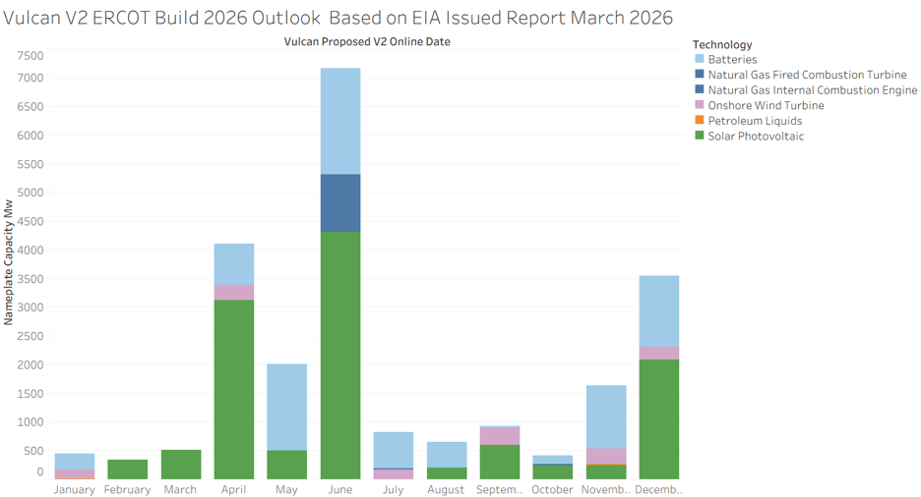
The current El Niño pattern creates real upside risk for summer demand and system stress. If weather conditions push toward the high end of forecast, tight system situations may be more common than a normal summer baseline would suggest. A generation build surge is expected before peak season, which raises its own modeling questions around which units actually come online on schedule.
This is precisely where Vulcan adds the most value. Before you finalize summer price scenarios, the more pressing question is whether your generation stack assumptions are correct.
How Vulcan Helps You Stay Ahead of Both Problems
NPRR 1330 addresses price formation for RMR dispatch. But accurate price modeling also requires an accurate generation stack — knowing which units are actually coming online, on what timeline, and at what capacity. That is the problem Vulcan was built to solve.
Vulcan provides unit-level generation build outlooks for ERCOT, structured so you can directly import them into your models via a simple VLOOKUP. You get:
Market rule changes like NPRR 1330 are important inputs. But they only matter if the generation stack you are modeling against is correct in the first place.
Get Vulcan’s Summer Generation Outlook
Email David Bellman at dbellman@synmax.com to access Vulcan’s unit-level generation build data for ERCOT.
Know what is actually coming online this summer — before your competitors do.
What You Now Know
Before NPRR 1330, SCED could dispatch Braunig Unit 3 ahead of competitive resources during constrained conditions, artificially suppressing the clearing price and displacing thousands of megawatts of competitive capacity — exactly as happened during Winter Storm Fern.
Under NPRR 1330, RMR units move to the back of the economic merit order. The market exhausts competitive alternatives first. The result is a price signal that better reflects actual scarcity — meaningfully higher than what Fern produced, even if the current MOC formula still has limitations.
If you model ERCOT summer prices, two actions follow from this: update your dispatch assumptions for RMR units, and verify your generation stack build assumptions against ground truth. Vulcan handles the second problem so you can focus on the first.
For questions or more information, contact David Bellman at dbellman@synmax.com
